
Revisiting Lencioni: From Dysfunction to High-Performance Function
Why do some teams thrive whilst others drift? Patrick Lencioni’s Five Dysfunctions of a Team is a powerful diagnostic tool which I've used with teams frequently. Whilst people can relate to the approach they can find the word 'dysfunctions' off-putting as it focusses on the negatives. So what if we reframed it as a blueprint for success? Instead of focusing on what’s broken, let’s explore the five functions of high-performing teams and how to spot opportunities for growth.
1. From Absence of Trust → Foundation of Trust
High-performing teams start with trust—not just "I trust you to do your job", but vulnerability-based trust. This means feeling psychologically safe to admit mistakes, ask for help, and share concerns.
Signs to watch for:
Do team members openly admit when they need help?
Are mistakes discussed without blame?
Practical Tip: Start meetings with quick check-ins or “learning moments” where leaders share something they got wrong. This sets the tone for openness from the outset.
2. From Fear of Conflict → Healthy Debate
Great teams embrace constructive disagreement or disagreeing agreeably as Rory Stewart and Alastair Campbell call it for any The Rest is Politics fans. Healthy debate leads to better decisions and stronger commitment.
Signs to watch for:
Are meetings too quiet or dominated by a few voices?
Does 'the boss' always have the last word?
Do decisions feel rushed or rubber-stamped?
Practical Tip: Assign a “devil’s advocate” role in discussions to ensure different perspectives are played in.
3. From Lack of Commitment → Shared Clarity
Commitment isn’t about unanimous agreement—it’s about clarity and buy-in. Even if not everyone gets their way, they should feel heard, understand the decision and support it.
Signs to watch for:
Do people leave meetings unclear on next steps?
Are decisions revisited repeatedly?
Practical Tip: End every meeting with a recap: What did we decide? Who owns what? When will it happen?
4. From Avoidance of Accountability → Mutual Accountability
High-performing teams hold each other accountable—not just the leader. This means calling out missed deadlines or poor quality in a respectful, constructive way.
Signs to watch for:
Is accountability only top-down?
Do deadlines slip without discussion?
Practical Tip: Introduce peer check-ins so progress is visible, issues are highlighted early, and responsibility for action is shared.
5. From Inattention to Results → Focus on Collective Success
The ultimate function is a shared focus on results—not individual wins, but team outcomes that matter to everyone.
Signs to watch for:
Are personal goals overshadowing team priorities?
Do celebrations focus on individual achievements?
Practical Tip: Regularly review team metrics together and celebrate collective success, not just individual contributions.
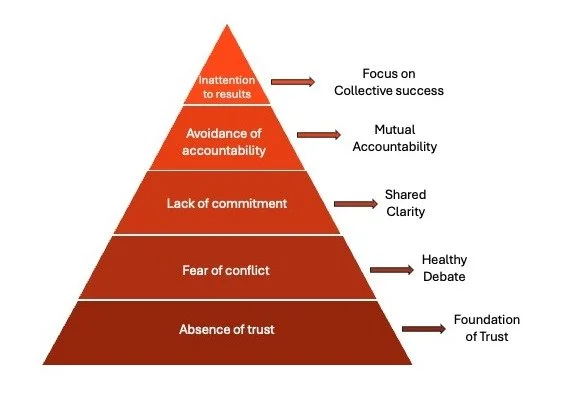
5 Dysfunctions of a team reframed as functions of a high performing team
Reframing dysfunctions as functions for high-performing teams shifts the focus from fixing problems to building strengths. It’s a more positive, actionable approach that resonates with teams aiming for excellence and growth.
Question for you: Which of these five areas feels most relevant for your team right now? How do you spot the signs? 👇 Share your thoughts in the comments—I’d love to hear your perspective.